Marketplace Gift Bundles for Sports and Recreation Products
September 17, 2026
A successful marketplace gift bundle is a new customer proposition, not leftover products placed in one box. It should solve a clear gifting mission, remain easy to understand on mobile, and produce attractive contribution after packaging, fees, fulfillment, discounts, returns, and media.
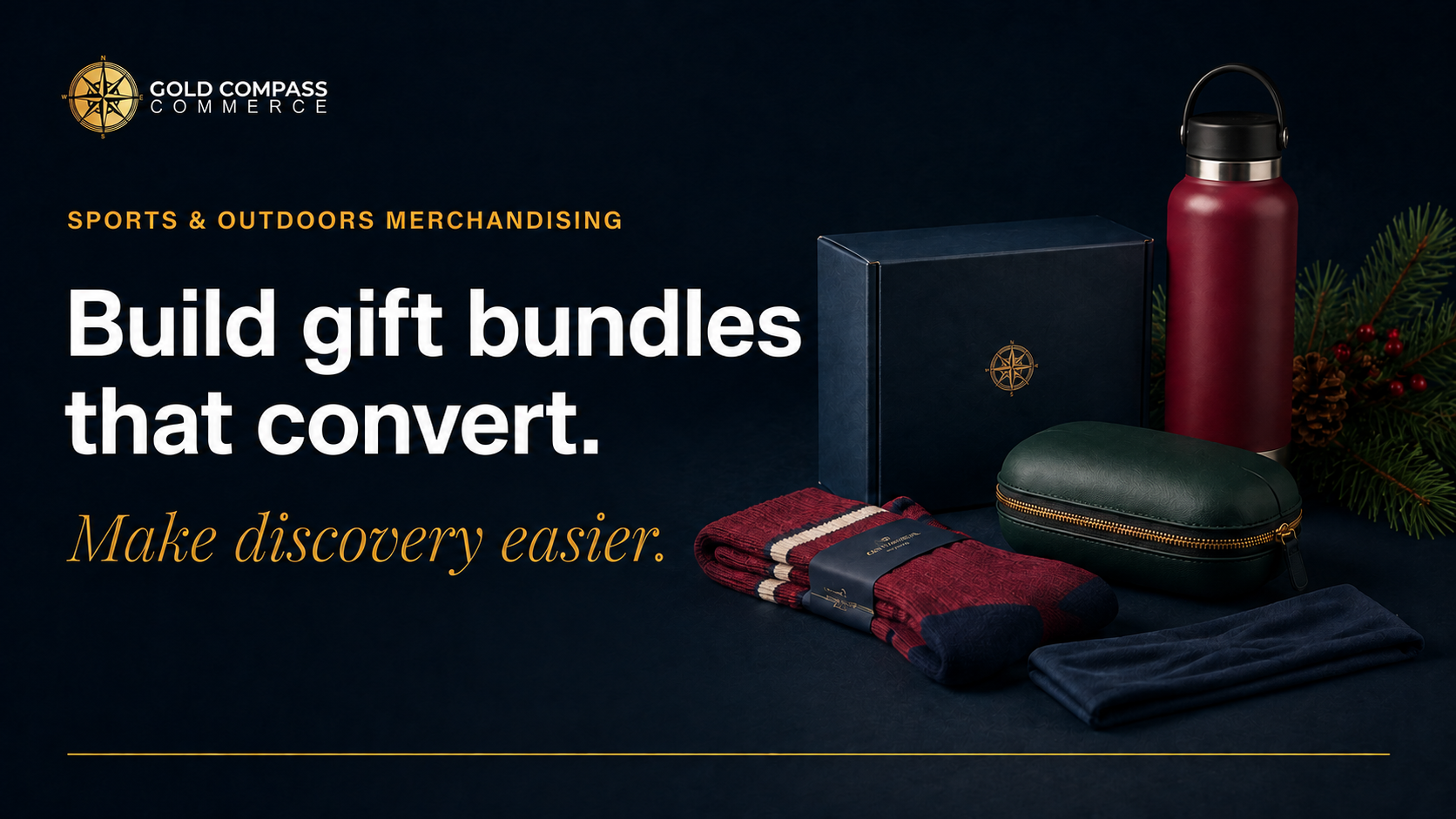
Sports and recreation categories are rich with bundle opportunities: beginner kits, travel sets, training packs, recovery routines, fan gifts, family activities, tournament essentials, and stocking stuffers. They also carry catalog and operational complexity.
For medium-to-enterprise brands, bundles require a shared commercial decision. The CMO and VP of Brand define the proposition, the CFO tests contribution and working-capital impact, the CRO and Head of Ecommerce assess portfolio growth, and operations, supply chain, content, and media teams ensure the bundle can launch, stay available, and perform as promised.
Begin with the recipient and occasion
Define the bundle in one sentence: “Everything a first-time pickleball player needs for a casual game,” or “A compact recovery set for the frequent traveler.” If the proposition requires a long explanation, the bundle is probably too broad.
Choose an occasion, recipient, expertise level, price band, and use setting. Avoid combining products merely because they share a category. The components should create more decision value together than separately.
Engineer the economics as a standalone SKU
Model component costs, assembly, packaging, inserts, labeling, inbound freight, Amazon fees, fulfillment dimensions, storage, damage, returns, promotions, and advertising. A bundle discount should reflect customer value without giving away the most profitable component.
Compare the bundle with separate-item economics. Consider whether it raises average order value, improves attachment, opens a new price tier, reduces choice friction, or recruits a new shopper. If it only shifts existing demand into a lower-margin configuration, the strategy needs work.
Choose components with operational discipline
The bundle is only as available as its scarcest component. Avoid using a hero item with constrained supply unless the bundle has strategic priority. Standardize assembly, quality checks, packaging durability, barcode governance, and component-change procedures.
For products with sizes, handedness, age ranges, or compatibility, minimize ambiguity. Too many configurations can create a catalog that is harder to manage than the customer problem warrants.
Create a distinct, accurate detail page
Amazon detail-page rules require accurate representation of the product being sold. The bundle should have clear product identity, images showing every included item, quantity and dimensions, intended user, limitations, and packaging. Do not imply that accessories or props are included when they are not.
Use secondary images to show the unboxing sequence, how the pieces work together, and who the bundle is for. Gift-ready does not necessarily mean wrapped; state the packaging experience accurately.
Plan the seasonal launch backward
Work backward from the gifting moment through review lead time, creative production, assembly, inbound receiving, and media learning. Launching too late can leave the brand paying high seasonal click costs with little social proof or inventory flexibility.
Separate evergreen gifting from event-specific creative so the asset can continue selling after the holiday or tournament window where appropriate.
Measure incrementality and portfolio effect
Track bundle conversion, contribution, return rate, new-to-brand share, attachment or halo where measurable, cannibalization of component SKUs, review themes, and residual inventory. A bundle can be strategically successful even if its direct ROAS is lower—if it attracts valuable new customers or improves inventory productivity—but that hypothesis must be measured.
FAQs
Should a bundle always be cheaper than buying separately?
No. Convenience, curation, packaging, or exclusivity can create value, but pricing must be clear and competitive.
Can brands bundle any related products?
Catalog, product, safety, and category rules apply. Validate the configuration and product-identification requirements before launch.
What is the biggest operational risk?
Component imbalance: one unavailable or defective item can stop the entire bundle.
How Gold Compass Commerce can help
Gold Compass Commerce helps sports and recreation brands evaluate bundle concepts, build the unit economics, plan marketplace setup, and coordinate content, media, and inventory for seasonal success.