Parent-Child Variation Strategy for Clothing and Accessories
September 3, 2026
Variation families are merchandising architecture. When correctly built, they help shoppers compare legitimate size and color choices on one detail page. When abused or poorly governed, they create catalog instability, misleading reviews, broken advertising, and operational confusion.
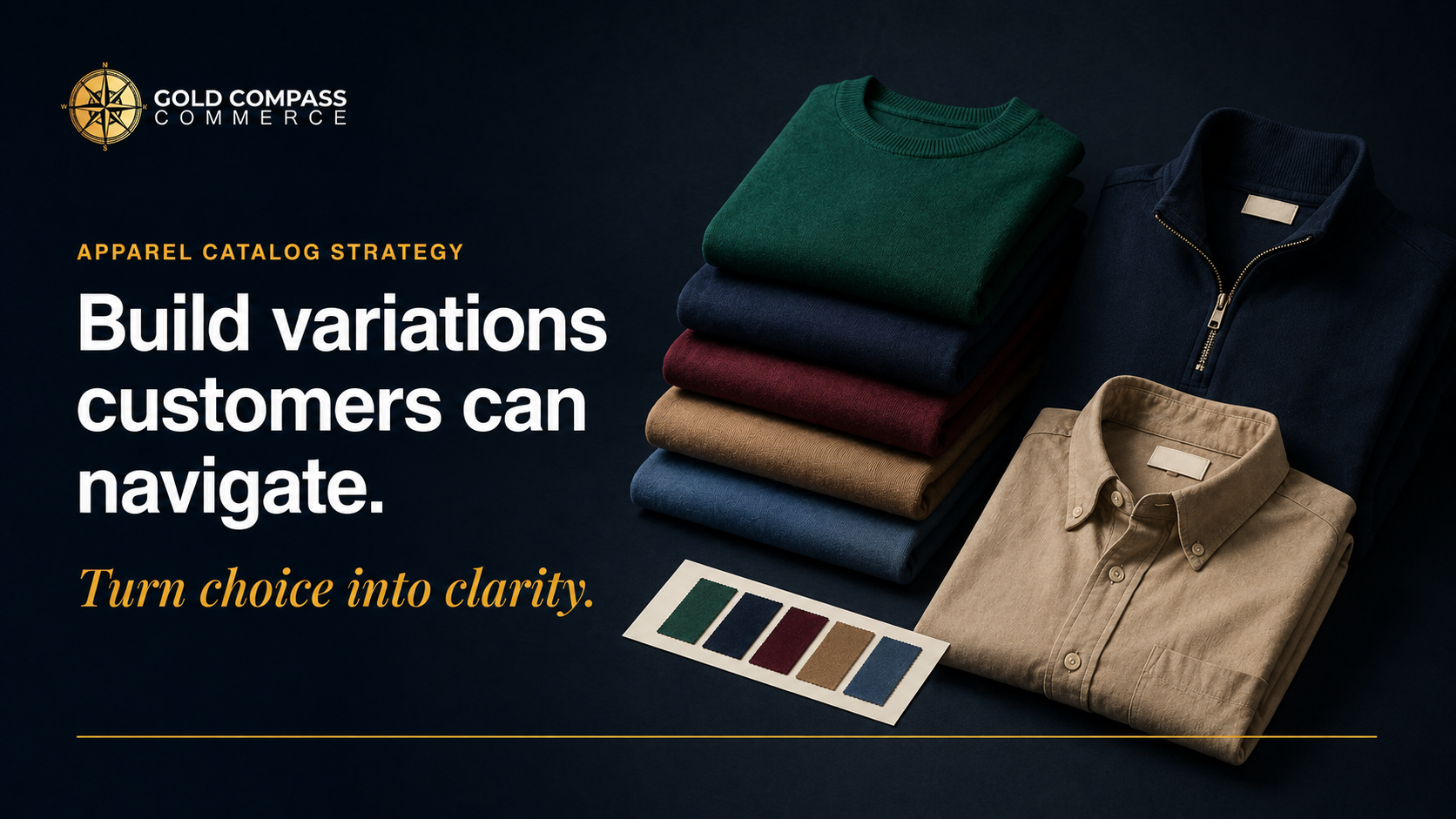
Amazon describes variations as related products that differ by defined attributes such as size or color. The strategic principle is simple: children should be the same fundamental product, and the variation theme must accurately describe the difference.
Define the product family from the customer’s perspective
Ask whether a shopper would reasonably expect to select among these options on one page. The same shirt in different sizes and colors is usually intuitive. Different silhouettes, materials, bundles, generations, or fundamentally different products may not be.
Do not use variations primarily to transfer reviews or traffic. That creates policy and customer-experience risk. Merchandising logic must lead.
Standardize variation attributes upstream
Large apparel catalogs often contain inconsistent color names, size values, department labels, and style identifiers across ERP, PIM, feeds, and Amazon. Create a canonical dictionary for:
- Size and size class
- Body type
- Color map and pattern
- Gender or department
- Style
Preserve customer-friendly naming while ensuring structured attributes are valid and consistent.
The parent is a non-buyable organizing entity; each child must carry accurate sellable-product data. Governance should prevent a parent value from masking differences among children.
Decide when to split a family
Split when products differ in ways that materially change the customer proposition: construction, fabric, fit block, feature set, included quantity, target user, or generation. Also consider operational clarity. An enormous family may become difficult to quality-assure, advertise, and replenish even if the theme is technically permitted.
Use sales and navigation data to understand how shoppers compare options, but do not let short-term performance justify an inaccurate relationship.
Protect variant-level content
Each child should have the correct color imagery, swatch, size, material, and availability. The detail page may share content across the family, so design common copy around truths that apply to every child. Put variant-specific differences in the correct attributes and assets.
Review mobile behavior. A family that looks clear on desktop can become a long, confusing selector on a phone.
Coordinate variations with inventory and advertising
Media can send shoppers to an unavailable or unrepresentative child. Monitor inventory and performance at child level, not only parent level. Define when a family is too fragmented to promote and when campaigns should point to a better-stocked child.
Reporting also needs care: parent-level views can hide weak children, while child-only reporting can miss shared traffic and review effects. Use both.
Monitor variation health
Track:
- Broken families and orphan children
- Suppressed ASINs and invalid themes
- Duplicate relationships
- Image mismatches and attribute conflicts
- Review anomalies
- Child-level stockouts
Maintain before-and-after exports and case documentation for remediation.
Because Amazon detail pages can reflect contributions from multiple sources, brands should verify the live result after feed updates rather than assuming the submission became the displayed truth.
FAQs
Should all colors and sizes be in one family?
Only when they are legitimate variants of the same core product under an allowed theme and the family remains usable.
Can different multipacks be variations?
It depends on category rules and the true product relationship. Validate the permitted theme and customer logic.
Why do variation families break?
Common causes include attribute conflicts, category changes, invalid relationships, feed errors, and competing catalog contributions.
How Gold Compass Commerce can help
Gold Compass Commerce helps apparel and accessories brands design, audit, and remediate variation architecture—connecting catalog accuracy with shopper experience, inventory, media, and reporting.