Why the Right Commerce Agency Works Alongside AI Instead of Competing With It
October 20, 2026
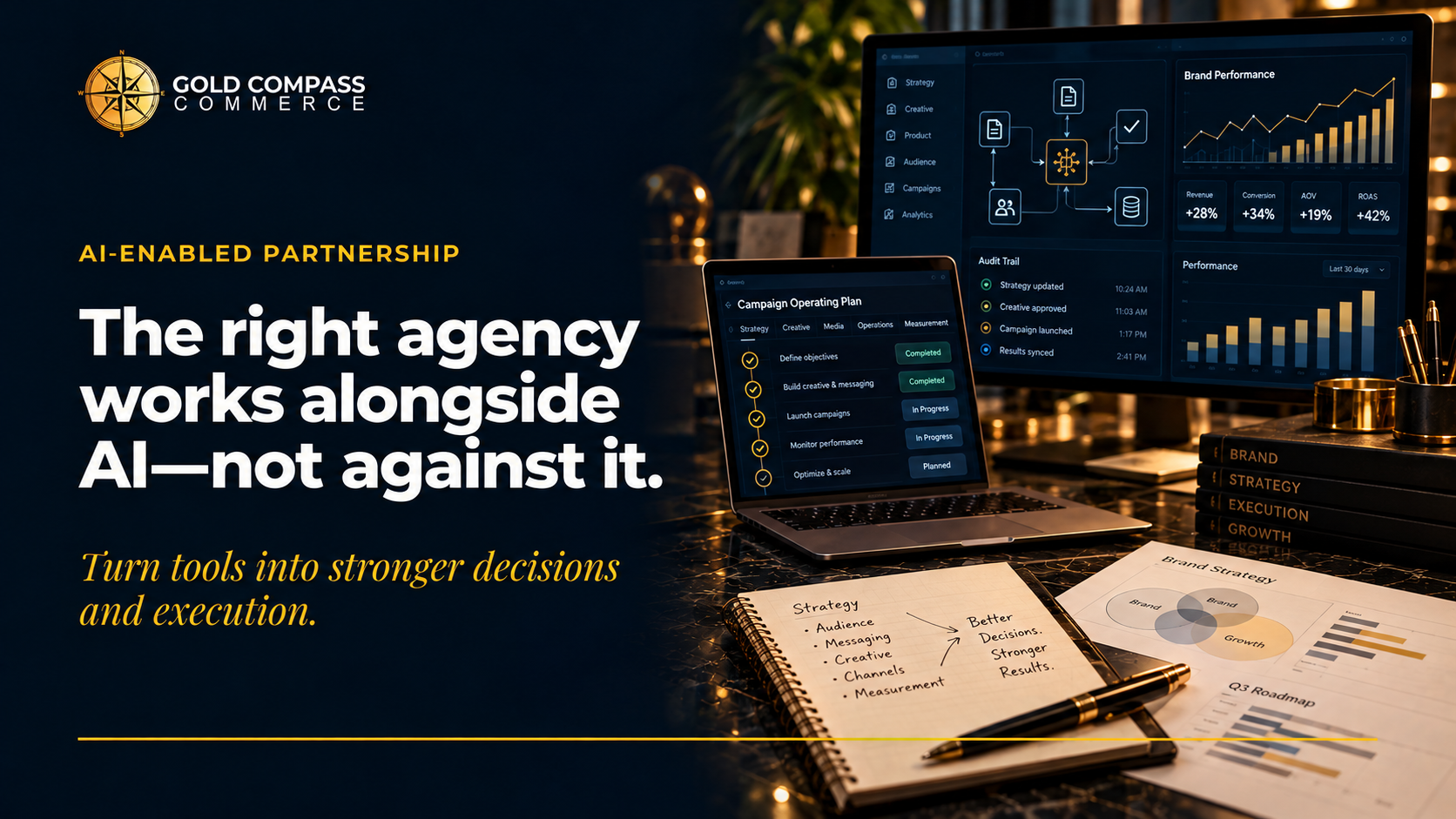
AI tools are changing how retail teams analyze data, create assets, monitor operations, and act on opportunities. The right agency should not protect manual work from automation. It should help the brand use AI with stronger context, governance, judgment, and accountability.
The operating challenge
Brands are gaining access to increasingly capable seller, advertising, creative, and analytics tools. Amazon has positioned its newer AI capabilities as force multipliers for sellers, including Seller Assistant workflows and AI-supported advertising. The value of an agency therefore shifts away from being the only party able to perform a task. It moves toward designing the operating system around the tool, validating its recommendations, and connecting outputs with the brand's economics and priorities.
The strongest response is cross-functional. Commercial, finance, operations, supply chain, content, media, technology, and customer teams do not need identical priorities, but they do need shared definitions and an agreed way to resolve tradeoffs.
A practical framework
- Treat AI as operating leverage rather than a threat to billable work
- Define which decisions may be automated and which require human approval
- Give tools the product, customer, margin, inventory, and brand context they lack
- Validate recommendations against source data and business constraints
- Keep an audit trail for material actions and continuously improve the workflow
Apply the framework first where the decision is valuable enough to justify the discipline. A focused product group or channel gives the team room to improve the process before scaling it across the organization.
Metrics that reveal progress
- Time saved in recurring workflows
- Recommendations accepted, modified, or rejected
- Errors prevented through human review
- Decision cycle time
- Incremental value relative to technology and service cost
Read these measures together. Improvement in one indicator should not conceal deterioration in contribution, availability, customer experience, or operating effort.
What to do next
Ask every agency to show how it uses the brand's existing AI and software stack. The answer should identify the data required, the human checkpoints, the decisions improved, and the outcomes measured. A strong partner makes the tools more useful while remaining accountable for judgment and execution.
Questions leaders should ask
- What decision will improve if we solve this problem?
- Which assumption has the weakest evidence today?
- Who owns the next action when functions disagree?
Gold Compass perspective
Durable ecommerce growth depends on an operating model that makes decisions visible, measurable, and repeatable. The goal is not another layer of reporting. It is a clearer connection between customer signals, channel execution, financial outcomes, and accountable action.
FAQs
Will AI replace commerce agencies?
AI will automate portions of analysis and execution. Brands will still need strategy, integration, governance, creative judgment, and accountable cross-functional leadership.
What should remain human-led?
High-impact decisions involving brand, customer risk, economics, policy interpretation, and tradeoffs across functions should retain clear human accountability.
How Gold Compass Commerce can help
Gold Compass Commerce helps retail brands connect marketplace strategy with the operating discipline required to improve growth, profitability, and execution. Contact us to discuss where your ecommerce model is creating friction or leaving value unresolved.