Agentic AI and the Next Era of E-Commerce Growth
August 26, 2026
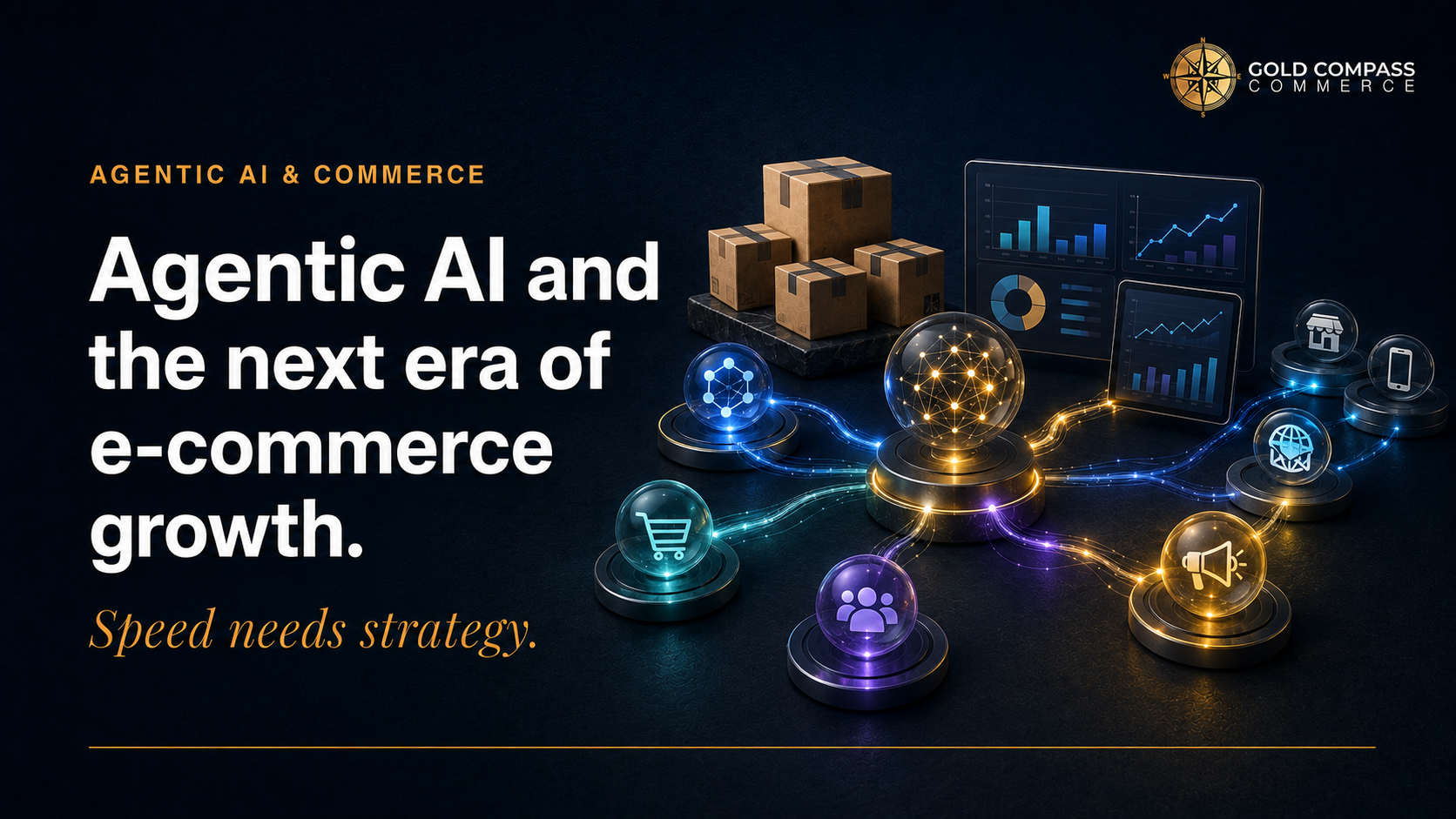
Every brand is experimenting with AI. Very few are architecting it.
Over the past eighteen months, "agentic AI" has moved from a research paper term to a boardroom priority. CEOs are asking their teams to "use AI more." CMOs are piloting AI content tools. CIOs are fielding vendor pitches for AI agents that promise to run entire workflows on their own. The question is no longer whether AI belongs in the growth plan. It's whether the organization has the discipline to use it well - or whether speed is quietly outrunning judgment.
From Generative AI to Agentic AI: What's Actually Changed
Generative AI writes. Agentic AI acts.
The first wave of enterprise AI has been about large language models (LLMs), chatbots, and copywriting assistants. These tools produced content on request. A person asked a question or gave a prompt, and the model responded. A human stayed in every step.
Agentic AI is different. An AI agent can be given a goal such as "keep this SKU in stock," "optimize this campaign to a target ROAS," "flag listings at risk of a buy box loss"... and then plan, take multiple steps, pull data from connected systems, and act with limited or no human input in between. Some agents work alone; increasingly, "multi-agent" systems hand tasks off to one another, each with a narrow job, coordinated by an orchestration layer. Techniques like retrieval-augmented generation (RAG) let agents pull from a brand's own data rather than relying only on what a model was trained on, which matters enormously for accuracy.
This is the shift executive teams need to understand since it can go right or critically wrong: agentic AI doesn't just draft the email. It can send it, adjust the bid, reprice the SKU, or reorder the inventory — at machine speed, continuously, across every channel at once.
Where Agentic AI Is Already Driving E-Commerce Growth
Five places this shift is already changing outcomes for brands on Amazon, Walmart, and DTC:
- Demand Forecasting and Inventory Allocation Agents that continuously ingest sales velocity, seasonality, and promotional calendars can adjust forecasts and reallocate inventory across channels in near real time — catching stock-outs and overstock before they hit the P&L, not after.
- Dynamic Pricing and Promotional Optimization Rather than a weekly pricing review, agentic systems can test and adjust pricing and promotions continuously against competitor movement, margin targets, and inventory position.
- Content Generation and PDP Optimization at Scale Product titles, bullets, A+ content, and imagery variants can be generated and tested across hundreds or thousands of SKUs simultaneously — a task that would take a content team months to do manually.
- Customer Service and Post-Purchase Agents Agentic support tools can resolve return requests, answer product questions, and escalate only the exceptions that genuinely need a human — improving response time without proportionally growing headcount.
- Retail Media and Advertising Optimization Autonomous bid and budget agents can shift spend across campaigns and platforms in response to real-time performance, something no human trafficker can do at the same speed or scale.
Used well, this is genuine acceleration towards business goals, the kind that used to require a much larger team, now compressed into hours instead of weeks.
The Pitfalls Leaders Are Underestimating
Here is what most brands are not accounting for: speed without discernment doesn't just fail to help. It compounds mistakes at scale.
Fragmented, ad hoc prompting. When every employee prompts AI tools differently, with no shared standards, the output is inconsistent — different tone, different accuracy, different quality — depending on who happened to write the prompt that day.
Unmanaged chat memory. Many consumer-grade AI tools retain conversation history by default. When employees paste in pricing strategy, unreleased product data, or supplier terms to get a faster answer, that information can persist in a vendor's memory well beyond the conversation — a real and often invisible data exposure risk.
Trusting public-domain information as fact. General-purpose AI models are trained on public data of uneven quality and can confidently generate information that is outdated, wrong, or entirely fabricated. Treated as truth in a board deck, a forecast, or a competitive analysis, a single hallucinated statistic can steer a very real and very wrong decision.
No human in the loop on autonomous actions. An agent empowered to reprice, reallocate ad spend, or edit live listings without a checkpoint is a liability the moment its assumptions are wrong — and agents don't pause to ask when they're not sure.
Department-level "shadow AI." Marketing, ops, and customer service each adopting their own tools in isolation recreates the same silo problem that undermines omnichannel strategy — no shared data, no shared standards, no way to measure the combined impact.
Confusing fast with right. The most common mistake isn't using AI. It's assuming that because an answer arrived instantly, it must be correct.
None of this is an argument against AI. It's an argument for governance and trusted expertise.
Why Discernment Is the New Differentiator
AI adoption is quickly becoming table stakes. Nearly every brand will use it in some form within the next year. That means it stops being a competitive advantage on its own. What separates the brands that compound growth from the ones that create expensive cleanup work is discernment: the ability to tell which AI-generated recommendation is signal and which is noise, before it reaches a customer, a budget, or a P&L line.
That discernment doesn't come from the tool. It comes from experienced operators who know what a realistic forecast looks like, what a defensible price looks like, and what a brand's voice actually sounds like. Then establishing checkpoints that catch the difference.
What Disciplined AI Adoption Looks Like
Brands getting real, compounding value from agentic AI tend to do the same things:
- Centralize prompt and data governance across departments rather than leaving it to individuals
- Use enterprise-grade tools with private, controlled memory instead of public consumer accounts for anything touching proprietary data
- Keep a human expert in the loop on any agentic action tied to pricing, inventory, or brand-facing content
- Validate AI-sourced data and claims against verified sources before they influence a decision
- Treat agentic AI as an operational capability owned across the business, not a tactic owned by one department
- Measure AI's contribution to profitability and market share — not just speed or content volume
Agentic AI Won't Replace Strategy. It Will Expose the Brands That Don't Have One.
AI accelerates whatever is already true about an organization. A brand with disciplined data, clear governance, and senior judgment will use agentic AI to scale faster and more profitably. A brand without that foundation will simply make its existing mistakes faster and at greater volume.
The opportunity in front of medium and large brands right now isn't just adopting agentic AI. It's partnering with experts who can separate the right information from the wrong, build the governance that keeps speed from becoming risk, and turn that acceleration into real market share.
Have questions about how agentic AI fits your marketplace and DTC growth strategy? Message the team at Gold Compass Commerce today and let's talk.
FAQs
What is agentic AI in e-commerce?
Agentic AI refers to AI systems that can pursue defined goals, make decisions, and complete multi-step tasks with limited human intervention. In e-commerce, these systems may help manage advertising, pricing, inventory, content, customer service, and marketplace operations.
How is agentic AI different from generative AI?
Generative AI primarily creates content in response to a prompt. Agentic AI can go further by planning and taking actions—such as adjusting advertising bids, identifying inventory risks, updating prices, or coordinating tasks across connected systems.
What are the biggest risks of using AI in e-commerce?
The greatest risks arise when AI acts on inaccurate data, incomplete business rules, or poorly chosen goals. At scale, it can compound overspending, pricing errors, inventory problems, compliance issues, and inconsistent brand decisions faster than a team can manually correct them.
Does agentic AI replace e-commerce experts?
No. AI can accelerate analysis and execution, but experienced oversight remains essential. E-commerce experts define the strategy, establish guardrails, evaluate tradeoffs, verify outputs, and ensure automated decisions support the brand's broader financial and commercial goals.
How can brands prepare to use agentic AI responsibly?
Brands should begin with reliable data, clearly defined objectives, limited permissions, approval thresholds, and measurable performance standards. Starting with controlled use cases allows teams to validate results before expanding AI's authority across channels or business functions.